
STORIES OF OUR FAMILIES
To forget one's ancestors is to be a brook without a source, a tree without a root.
The Nidhe Israel Synagogue & Museum - Barbados
A personal perspective
The history of my family and that of many other families seems to be intertwined in one way or another with religion. My family history includes Presbyterian ancestors in Madeira fleeing to Trinidad and Jewish ancestors in Portugal fleeing to Amsterdam and beyond because of religious persecution.


June 2026


In the heart of the city of Bridgetown, the bustling capital of Barbados, there lies a quiet and peaceful sanctuary. It bears living testimony to the people whose daily lives revolved within and around its surrounding walls starting in the mid-17th century. Within those ancient walls I imagine the social gatherings over the decades - people from far away countries, perhaps describing their journeys in ships that brought them from Europe and other lands. It is where they prayed, where their families gathered and practised the traditions of their homeland and rituals of their faith as best they could. They were the Sephardim - Jewish men and women originating in the Iberian Peninsular. Fearful of the terrible Portuguese Inquisition, they had landed in Barbados to start a new life where they felt safe. There they could own property, trade globally, and live outside of ghettos. They were some of the earliest settlers in the island.
On entering this beautifully maintained urban space recently, I was transported by what I can only describe as a feeling of poignant ancestral heritage. The intense emotion surprised me. It felt like an oasis for thoughtful reflection. For it is here that part of my European roots were transplanted in the island in the 19th century. Roots that originated in Portugal, ancestors who had immigrated to Amsterdam, London, Suriname and finally to Barbados. These ancestors of mine were active in the affairs of this small but historically significant Sephardi community. I sat alone in the synagogue and looked up and all around, taking in the meticulously preserved details. It reminded me of the Esnoga - The Portuguese Synagogue in Amsterdam that I'd visited - yet this one felt more intimate. I learned for the first time that Jewish women had their own entrance to the synagogue located at the back of the building. An impressive dual staircase leads to the mezzanine gallery of the synagogue from which they prayed, overlooking their menfolk. Their roles in the community were defined. The mikvah where they had their ritual bath, was supervised by one of my kin - Mrs. Lobo - who also lived within the compound.
My ancestral women taught the island's Sephardic Jewish youth within this historic compound. I imagine that in addition to strict religious studies, children (especially boys as they approached their Bar Mitzvah) were taught the practical skills needed to survive in the colonial British West Indies, which often included arithmetic, English literacy, and bookkeeping. Their fathers were merchants and traders in nearby Swan Street, where they lived and operated their business.
My family ceased belonging to the Jewish faith in 1870 when my great-great grandfather, Daniel Lobo, raised in this tight-knit Sephardic community, married a Christian woman. Daniel was the great-grandson of the Chief Rabbi at London's Bevis Marks, Haham Moses Cohen D'Azevedo. I thought of the enormity of that as I sat pondering with the knowledge I'd gained about my ancestors. Still, the names of our people remain etched in the Jewish history of those times. Lobo, Azevedo, Lindo, Finzi, Daniels - are all recorded in the sacred Minute Books. The first Sephardim to arrive in Barbados built the Nidhe Israel Synagogue, consecrated in 1654. After it was destroyed by a fierce hurricane in 1831, my ancestors were instrumental in the rebuilding of their place of worship. They would most certainly have attended the ceremony on 29 March 1833, described in the Introduction of Shilstone's historic book:
"About three of the clock on a bright and sunny afternoon in the month of March, 1833, the people of the Hebrew Nation in Bridgetown, Barbados, commenced to assemble in the courts and avenues of their Synagogue, and in the course of an hour, they were joined by a number of the most respectable inhabitants, and ladies of grace, fashion and beauty (admitted to the galleries) to witness the interesting and impressive ceremony before them. "It was a day that would ever stand eminently distinguished in the annals of the Hebrew community of the town", prophesied the editor of the Barbados Globe.
The occasion was the consecration of the new Synagogue, built to replace a former building on the same site within whose hallowed walls, for possibly two centuries they had long been accustomed to assemble and chaunt a solemn worship in an ancient tongue, with ceremonials and religious observances that constantly re-animated their high enthusiasm into holy joy". The former synagogue, like so many of the churches of the island, had been so shattered by the calamitous hurricane of 1831, that it was found necessary to raze it altogether to its very foundations. Through the liberality of their community, the indefatigable exertion of the leading members, and the unwearied zeal of a select committee of their body, this remnant of the ancient congregation, Nidhe Israel - "the dispersed of Israel", had provided a new structure of exquisite taste and chaste design, for the exercise of their faith and worship."
Much has been written by historians and scholars about the diminished Jewish community and tragic demise and deconsecration of the ancient synagogue in the thirties. I think desecration more aptly describes what was done. But around that time came hope for the congregation. A new wave of Jewish immigrants fleeing Nazi persecution in the lead-up to World War ll arrived on the island from Eastern Europe. They were the first Ashkenazi Jewish settlers in Barbados. It is thanks to them and their offspring, together with two important Barbadian statesmen, that the magnificent Synagogue, Mikvah, surrounding buildings and sacred burial grounds have been preserved. In addition, the rich history of the Jews' contribution to the island of Barbados is beautifully told in their very own museum within the compound.
The rescue and restoration of the Nidhe Israel Synagogue, the oldest synagogue in the Western Hemisphere, stands today as a monumental achievement born out of an unusual alignment of political will. The site was ultimately saved through the collective decisions of The Rt. Hon. Tom Adams, QC and The Right Excellent Errol Walton Barrow, PC QC - the first two prime ministers of independent Barbados.
The Right Excellent Errol Walton Barrow PC QC
1st Prime Minister of Barbados
In office 29 May 1986 – 1 June 1987 (Wikipedia)
The illustrious life and career of Prime Minister Barrow is well documented. He died in office at the age of 67 and was posthumously honoured as a National Hero of Barbados.
Prime Minister Barrow was a staunch, vocal supporter of Israel and frequently asserted that he possessed Jewish ancestry. He proudly maintained that he was a descendant of the prominent Baruch Lousada family, a Sephardic Jewish dynasty with deep roots in the Caribbean.
Shilstone recorded the deaths and burials of Simon Barrow (Baruch) and several others of his family in the Nidhe Israel Cemetery. According to Simon Kreindler in his book "Peddlers All', two Barrow gravestones were also discovered in 2016 during excavation work for the Synagogue Block Redevelopment Project.
As the Leader of the Opposition in 1984, Errol Barrow broke standard political lines to strongly support Adams’s initiative to save the Nidhe Israel Synagogue and its surroundings from being demolished. It is my opinion that Barrow’s enthusiasm for the project was not only because it was a sound decision which would also serve to promote the island's tourism. I believe it was also deeply rooted in his own knowledge and awareness of his Jewish lineage.
Thanks to the combined legacy of these two Barbadian founding fathers and the drive and dedication of Sir Paul Altman and his family who sought wide support for the restoration of the Nidhe Israel Synagogue, it was not only spared from the wrecking ball but fully revived to its former architectural glory. Today, it serves as an active house of worship, a museum, and a UNESCO World Heritage site - a testament to two prime ministers whose personal histories tied them directly to the Jewish community.
The Right Honourable Tom Adams QC
2nd Prime Minister of Barbados
In Office September 8, 1976 – March 11, 1985 (Wikipedia)
The Jewish Ancestry of Genevieve (Turner) Adams,
Wife of Prime Minister Tom Adams
The Benda Family
The Bendas were a Jewish family from Bavaria. According to Mrs. Adams, they probably originated in Czechoslovakia The family’s British history began with Anton Benda, the son of Saligman Benda. Looking for new opportunities, Anton left Germany and arrived in London in 1846, establishing himself as a merchant in the City of London. He specialized in importing Oriental goods, primarily from Japan.
In 1853, Anton married Frances Mandelbaum, whose father, David Mandelbaum, was also from Bavaria. Their traditional Jewish wedding was officiated by the Chief Rabbi. Just two years later, in 1855, Anton officially became a naturalized British citizen. Anton and Frances settled in Islington, North London, where they raised their family of eight children. The family operated their import business directly out of a large, extended family home in North London.
Family dynamics changed drastically when, in 1885, their eldest son, Sigmund Anton, married out of the Jewish faith to Annie McNicoll. They were Genevieve’s great-grandparents. Because Annie was not Jewish, Jewish law (Halakha) dictated that their children were not born Jewish. Sigmund’s branch therefore would have effectively ceased to be recognized as part of the formal Jewish community. Together, Sigmund and Annie had two sons, George and Douglas Benda.
Douglas married Edith Ada Winder in 1901, they were Genevieve’s grandparents. The couple’s lives soon became swept up in the tragedies of the early 20th century. Douglas served his country in the First World War, standing as an early example of British Jews who fought in regular, non-specifically Jewish army divisions. Sadly, Douglas was severely gassed during the war. He never fully recovered and died a few years later in 1924, leaving Edith as a single, working mother to raise their only child, a daughter named Hazel Edith. In 1937, Hazel Edith Benda married Philip Turner. They had two daughters, Antonia and Genevieve.
From Islington, London to Barbados
As a young woman, Genevieve took a job in the British capital, working as a secretary for the prestigious BBC World Service. It was here, in the late 1950s, that she met a brilliant young Barbadian broadcaster and law student at Gray's Inn - Jon Michael Geoffrey Manningham "Tom" Adams, the son of the prominent Caribbean statesman Sir Grantley Adams. The two fell in love and married in 1962. In 1963 Genevieve's life took an extraordinary turn when she moved to Barbados with her husband as he prepared to enter Barbadian politics alongside his father.
Thirteen years later, in 1976, Genevieve's Tom became the second Prime Minister of Barbados. He served from 1976 until his sudden death in 1985 when he was only 53. He had left behind his wife of 23 years, their two young sons and a shocked nation mourning his loss.
As the First Lady of Barbados during her husband's tenure as Prime Minister, Genevieve served as the island's premier hostess at their official residence, Ilaro Court. She notably hosted international dignitaries alongside her husband, including welcoming U.S. President Ronald Reagan and First Lady Nancy Reagan during their official diplomatic trip to Barbados in April 1982.
Thus Genevieve, great-great-grandaughter of the Jewish Bavarian merchant who arrived in London with a dream of importing goods, took her place in history within the highest office of a Caribbean nation.
(Source for the Benda story: "Peddlers All" - see link in research credits below)
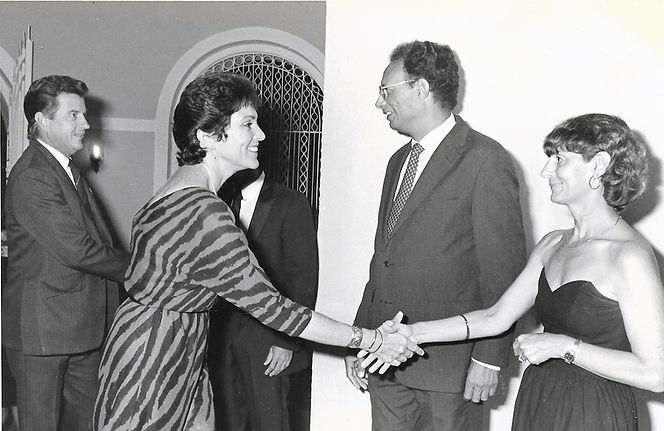
A reception for executives of the business community at Ilaro Court, Barbados - 1982
My husband J.A.K. (Tony) Archer and I being greeted by Prime Minister Tom Adams and his wife Genevieve
In the photo below Aaron Truss stands near the doorway. His father, Motel Truss, was one of the Ashkenazi Jews who came to Barbados in the thirties.

Above: A signed 8 x 10 photo sent to us after the event
Both photos bear the stamp "Willie Alleyne Associates Photography Ltd."

My research was done through:
-
Simon Kreindler's books: "Peddlers All" and "The Sephardi Jews of Barbados"
-
Eustace Shilstone's "Monumental Inscriptions in the Burial Ground of the Jewish Synagogues at Bridgetown, Barbados"
-
Visits to The Shilstone Library in the Barbados Museum
-
Visits to the Nidhe Israel Cemetery and Museum in Barbados
-
Visits to The Barbados Archives
-
Visits to the Barbados Nidhe Israel Synagogue and graveyard
-
Genealogy internet sites such as Sephardic Genealogy and Facebook groups
-
Collecting and archiving family documents and photos
-
More reading about Caribbean Jews:
-
Diaspora: Miracle in Barbados
-
Laura Leibman's "Once We Were Slaves: The Extraordinary Journey of a Multi-Racial Jewish Family"
Valerie Sheppard
7 July, 2026
As we get to know more details about the history of the Sephardim, these webpages will be updated and/or corrected.